
Christmas, one of the world’s most widely celebrated holidays, has roots stretching back over a thousand years. It gained prominence in the 4th century when 25 December was adopted by the Roman Church to mark the birth of Jesus Christ, influenced partly by earlier winter solstice traditions. Over time, Christmas customs like home decorating, gift-giving, and gatherings with loved ones became cherished traditions.
Postage stamps, initially created to facilitate postal payments, gradually evolved into a way to also commemorate important events and festivities. Given its significance, Christmas has been celebrated through commemorative stamps issued by many countries around the world.
What Was the First Christmas Postage Stamp?
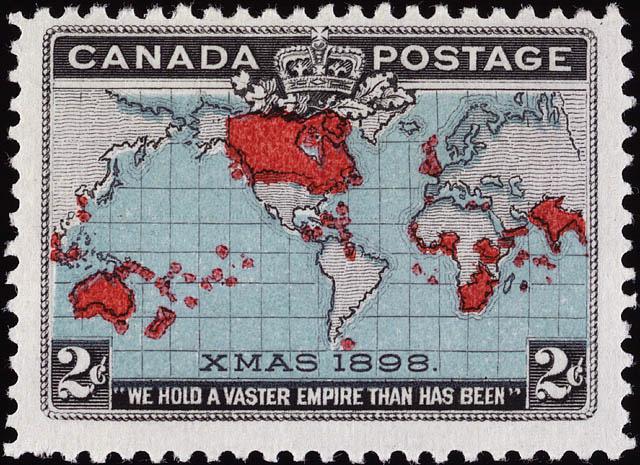
Canada’s two-cent stamp from 1898 is widely regarded as the first “Christmas postage stamp,” although it was not originally intended to celebrate the holiday. Issued on 7 December 1898 in blue and lavender varieties, this iconic stamp features a world map with British Empire territories highlighted in red. Queen Victoria’s crown is displayed at the top, accompanied by the phrase “WE HOLD A VASTER EMPIRE THAN HAS BEEN,” symbolising the Empire’s vast reach. Just above this phrase, the term “XMAS 1898” appears which led to the stamp’s informal recognition as the first “Christmas stamp.” However, its official purpose was to mark the introduction of Imperial Penny Postage, a unified postage rate across the British Empire.
Why “XMAS”?
Canada’s Postmaster General, Sir William Mulock, timed the new penny postage rate to take effect on 25 December 1898 as a symbolic gesture of Christmas unity across the Empire. The word “XMAS” on the stamp helped cement its association with Christmas, lending it the distinction of the first Christmas stamp in a historical sense.
Other Early Christmas Stamps
In 1935, Egypt issued a “Christmas Seal” for British Forces troops, which in the mid-1960s gained recognition among collectors as a postage stamp, as it prepaid postage. The stamp features an overprint of “XMAS 1935 – 3 Milliemes,” linking it to Christmas through the inclusion of the term “XMAS.”

In 1937, Austria released two greeting stamps featuring a rose design and zodiac symbols.
Click here to purchase them on eBay. (Disclaimer: This is not an affiliate link.)
In 1939, Brazil issued four semi-postal Christmas stamps with unique festive designs:
- The Three Wise Men with gifts and a guiding star,
- An angel and a child,
- The Southern Cross constellation and a child, and
- A mother and child.
Click here to purchase them on eBay. (Disclaimer: This is not an affiliate link.)
Hungary: Pioneer of Christmas Postage Stamps
Hungary was the first country to explicitly design a postage stamp for Christmas. In 1941, Hungary issued a semi-postal stamp, and the extra fees from the stamps were used to finance “soldiers’ Christmas.” This was followed in 1943 by a set of Nativity-themed stamps, which were the first to depict the Nativity, solidifying Hungary’s pioneering role in Christmas philately.
In the 1950s, countries like Cuba (1951), Haiti (1954), Luxembourg and Spain (1955), and Australia, South Korea, and Liechtenstein (1957) joined in issuing Christmas stamps. This practice has since become an annual tradition worldwide.
The World’s First Christmas Seals (Denmark) & The First U.S. Christmas Stamp
While the U.S. initially issued Christmas Seals rather than postage stamps, the world’s first Christmas Seals originated in Denmark. These seals resembled postage stamps but held no postal value, serving instead as a fundraising initiative. Danish postal worker Einar Holboell introduced Christmas Seals in 1904 as a way to raise money to build a children’s hospital for tuberculosis treatment, an issue affecting many at the time.
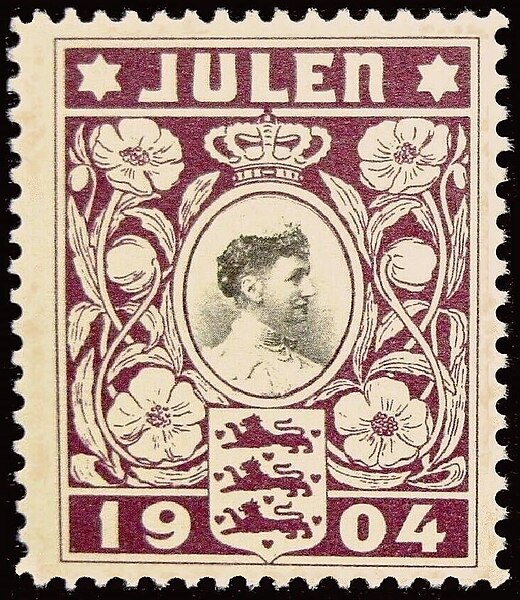
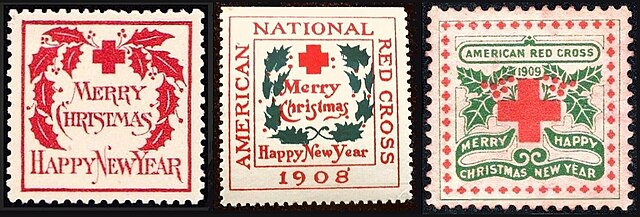
The idea quickly gained popularity, and by 1907, Emily Bissell, an American Red Cross volunteer, adopted it to raise funds for a tuberculosis sanatorium in Delaware. By the following year, Christmas Seals became an established method for raising awareness and funds.
The First U.S. Christmas Postage Stamp
In the 1930s and 1940s, two postmasters, Joseph Conrad and Leopold Morris, advocated for Christmas postage stamps, arguing they would not only be profitable for the post office but also encourage people to use First Class Mail instead of cheaper options. At the time, First Class Mail was more efficient as Third Class Mail often went undelivered or was destroyed.
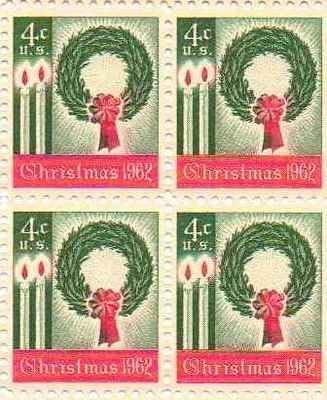
They further supported the idea of Christmas postage stamps as a way to promote messages of peace and goodwill during wartimes in Europe. Additionally, some customers were already combining different postage stamps to create a festive, Christmas-like appearance on their mail. After thousands of requests, Postmaster General J. Edward Day announced at the Chicago COMPEX stamp show in May 1962 that the first official U.S. Christmas stamp would be issued. The first U.S. Christmas stamp was released on 1 November 1962 in Pennsylvania. It was a 4-cent stamp, featuring a green wreath with a red bow and two candles, with the words ‘Christmas 1962.’ Its overwhelming success established Christmas postage stamps as an annual tradition.
Debates in Philately: The True First Christmas Stamp?
Philatelists continue to debate which country truly issued the first Christmas postage stamp, with some arguing that Canada’s stamp was not explicitly for Christmas, while others believe Hungary was the first country to issue a clearly designated Christmas postage stamp.
Despite varying opinions, the general consensus recognises Canada’s 1898 stamp as the first with Christmas-related themes and Denmark as the originator of Christmas Seals.
We would like to hear your points of view on the first Christmas postage stamp in the comments below.