
Admiral Mahé de La Bourdonnais Postage Stamps
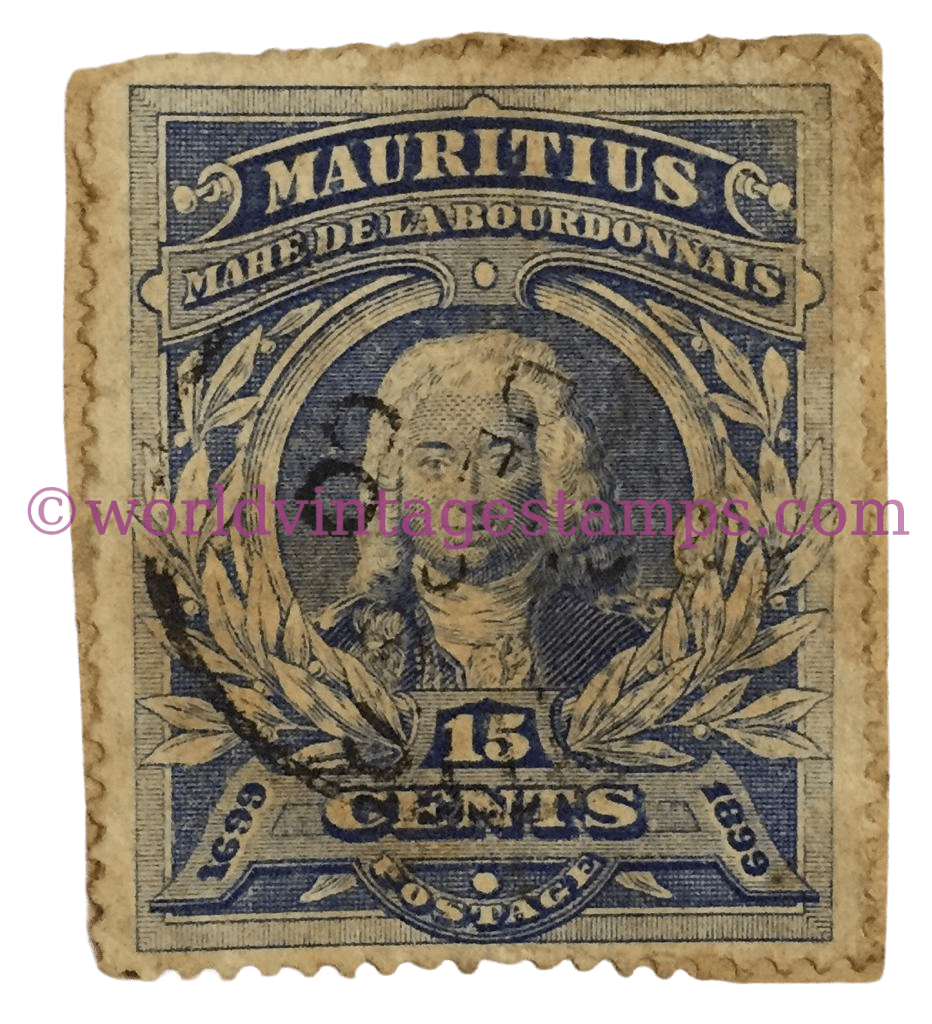
Issues on: 1889-12
Face Value: 15 Mauritian Cent
Emission: Commemorative
Watermark: CC under Crown Type 1 [Up]
In September 1715, the French assumed control of Mauritius, bestowing upon the island the name “Isle de France.” Despite this, work didn’t begin until six years later. However, it was when the Governor Bertrand-François Mahé de La Bourdonnais arrived in 1735 that various initiatives took place. These initiatives included cultivating spices in Jardin Pamplemousses, establishing a ship base in what is now known as Port Louis, and the construction of some major buildings. Some of the structures from that era still stand today, such as the Château de Mon Plaisir in Pamplemousse and Line Barrack.
Mahé de La Bourdonnais was born on February 11th, 1699. His bicentenary was celebrated by Mauritius in 1899. As part of the commemoration, Mauritius issued a postage stamp to honor his legacy.
Special Delivery Stamps
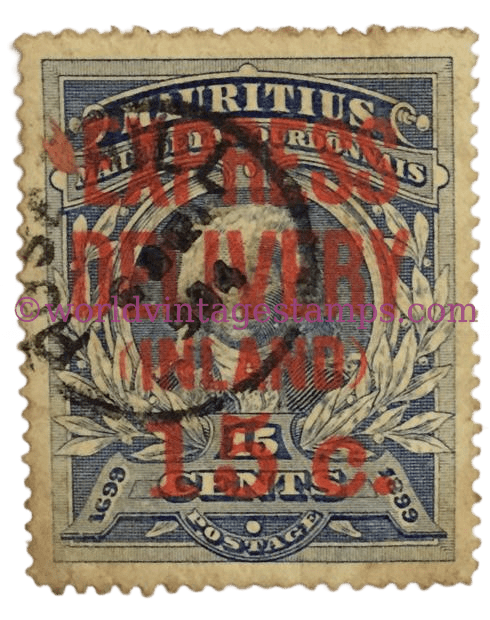
Surcharged in Red
Issued on: 1903-08-10
Face Value: 15 Mauritian Cents
Emission: Special Delivery
Watermark: CC under Crown Type 1 [Up]
Description: Overprint “EXPRESS DELIVERY (INLAND) 15c”
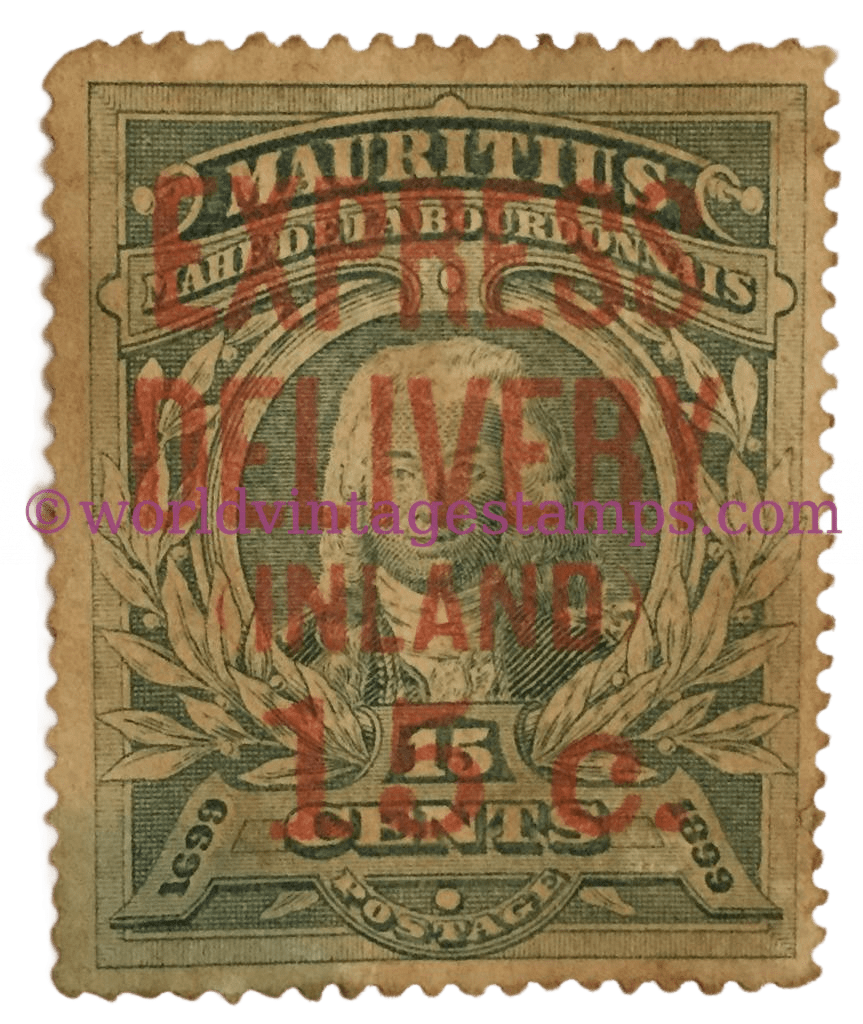
Surcharged in Red
Issued on: 1904-03-28
Face Value: 15 Mauritian Cents
Emission: Special Delivery
Watermark: CC under Crown Type 1 [Up]
Description: Overprint “EXPRESS DELIVERY (INLAND) 15c”
The term ‘Overprint’ here represents the ink stamp that has been applied to this postage stamp to indicate that the client requires Express Delivery. This means their postage will be sent more quickly than through standard delivery. The postage may receive prioritized handling, and as a result, the client probably incurred a higher cost for this service. The term ‘Inland’ signifies that the postage is destined for a domestic region within the country. In this context, it specifies that the postage will be delivered within Mauritius itself, rather than abroad.
Bird Definitives Postage Stamps
Mascarene Paradise Flycatcher (Terpsiphone Bourbonnensis)
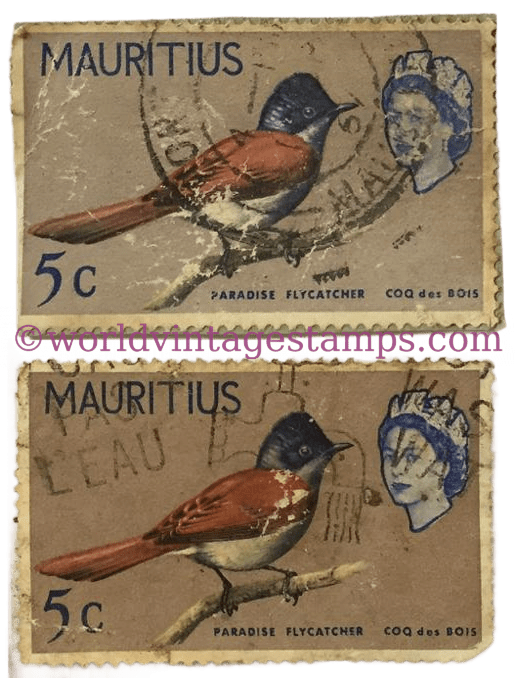
Issued on: 1965-03-16
Face Value: 5 Mauritian Cents
Series: Bird Definitives
Emission: Definitive
Watermark: St. Edward’s Crown Block CA Multiple [Up]
The Mascarene Paradise Flycatcher, also known as the Coque des Bois (scientific name Terpsiphone bourbonnensis), measures about 15-20 cm in length, including its tail. This small passerine bird species is native to the Mascarene Islands in the Indian Ocean, including Mauritius and La Réunion. The male Flycatcher bird has a blue-black head, a bright blue eye ring, chestnut tail and upperparts, grey lowerparts, and some white feathers. In contrast, the female flycatcher is smaller, has a shorter tail, and displays brownish and grey plumage. They inhabit forests, such as those found in Bras D’Eau National Park in Mauritius, and primarily feed on insects.
Mauritius Fody (Foudia Rubra)
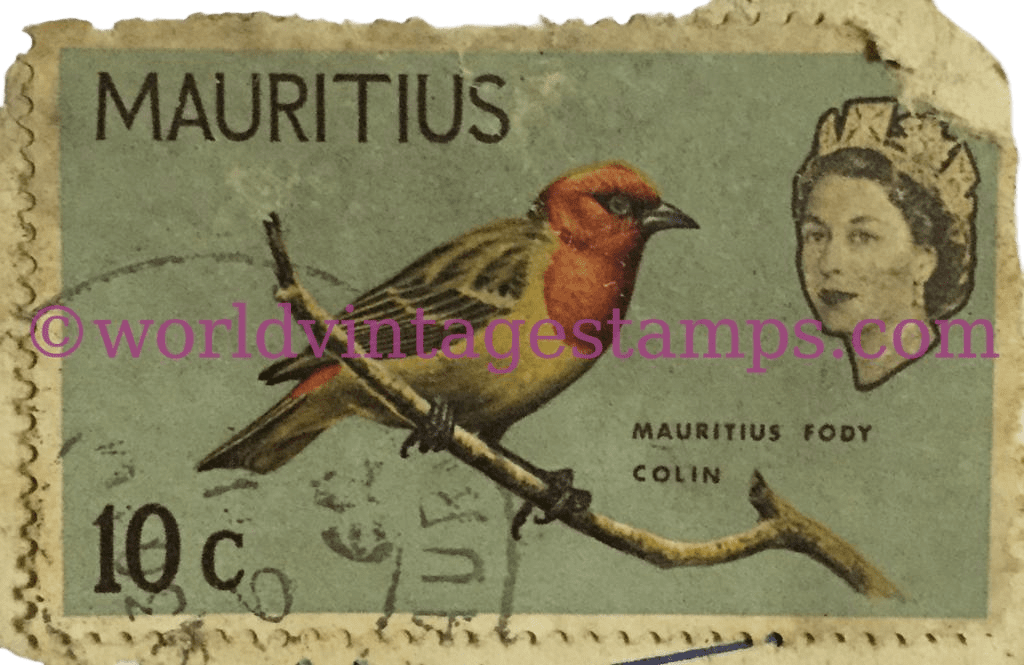
Issued on: 1965-03-16
Face Value: 10 Mauritian Cents
Series: Bird Definitives
Emission: Definitive
Watermark: St. Edward’s Crown Block CA Multiple [Up]
The Mauritius Fody, scientifically known as Foudia Rubra, is a rare member of the weaver family and is found exclusively on Mauritius Island. Regrettably, this bird is classified as “Endangered” by both BirdLife International and the United States’ Endangered Species List. Breeding male Fody birds exhibit distinctive characteristics such as a reddish-orange head, a black mask encircling their eyes, and plumage marked with greenish hues mixed with black patterns. In contrast, female and non-breeding male Fody birds display an olive-green appearance with subtle black markings. They primarily inhabit forested, woodland, and plantation areas, and they have been introduced to Ile aux Aigrettes. Their diet mainly consists of insects, berries, and nectar.
The 150th Anniversary of the British Post Office in Mauritius
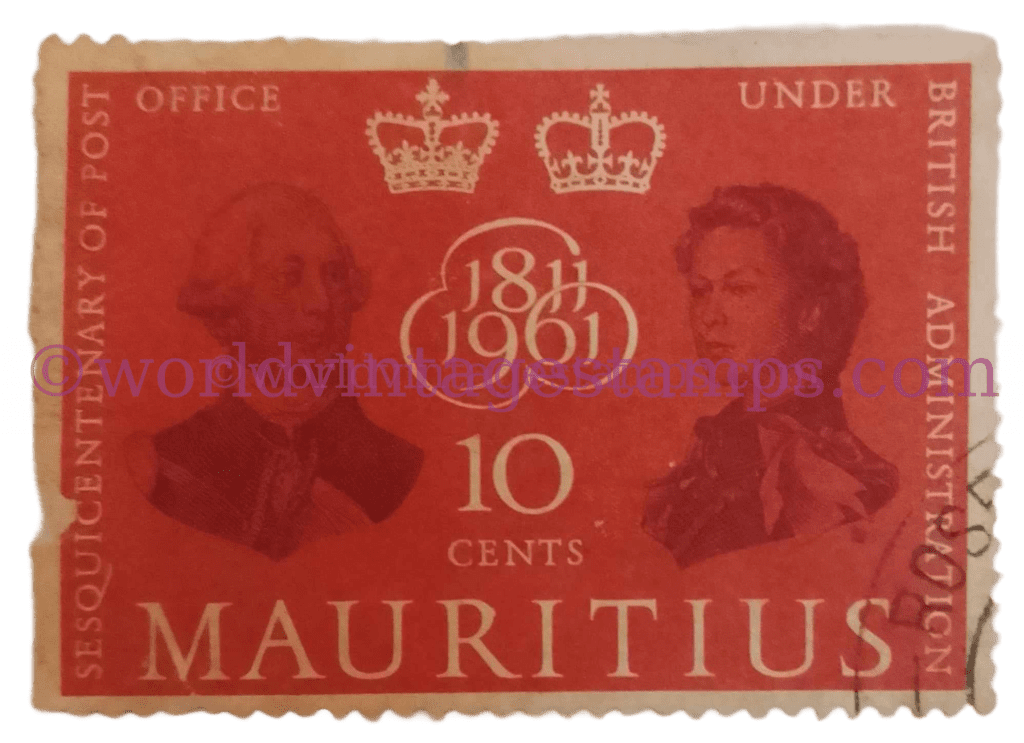
Face Value: 10 Mauritian Cents
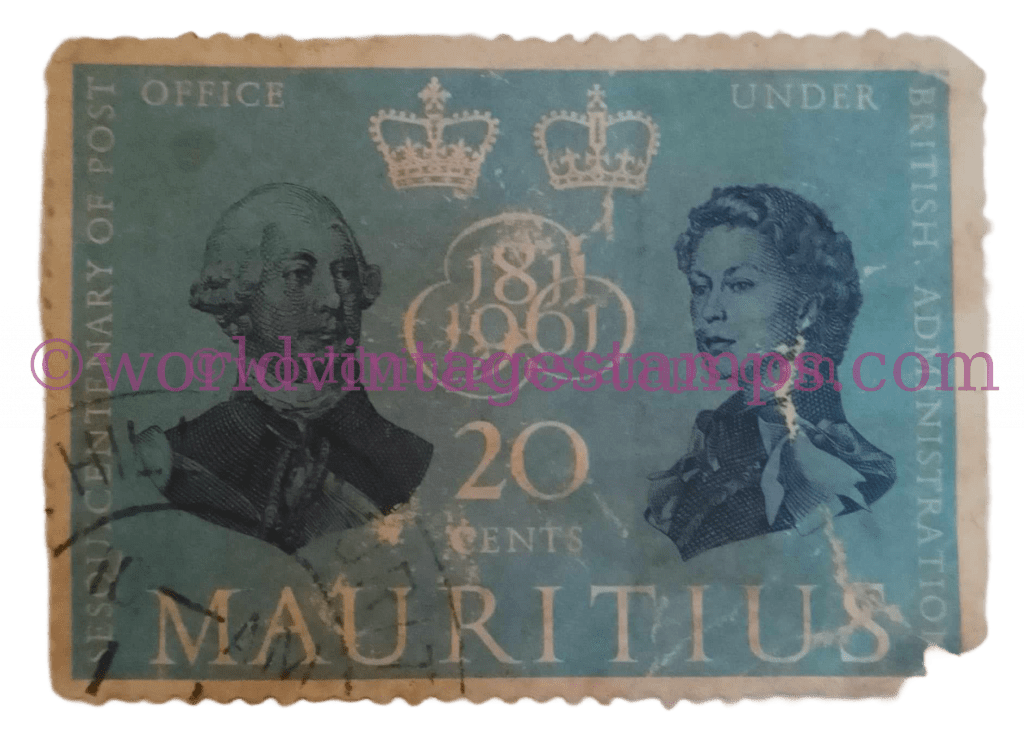
Face Value: 20 Mauritian Cents
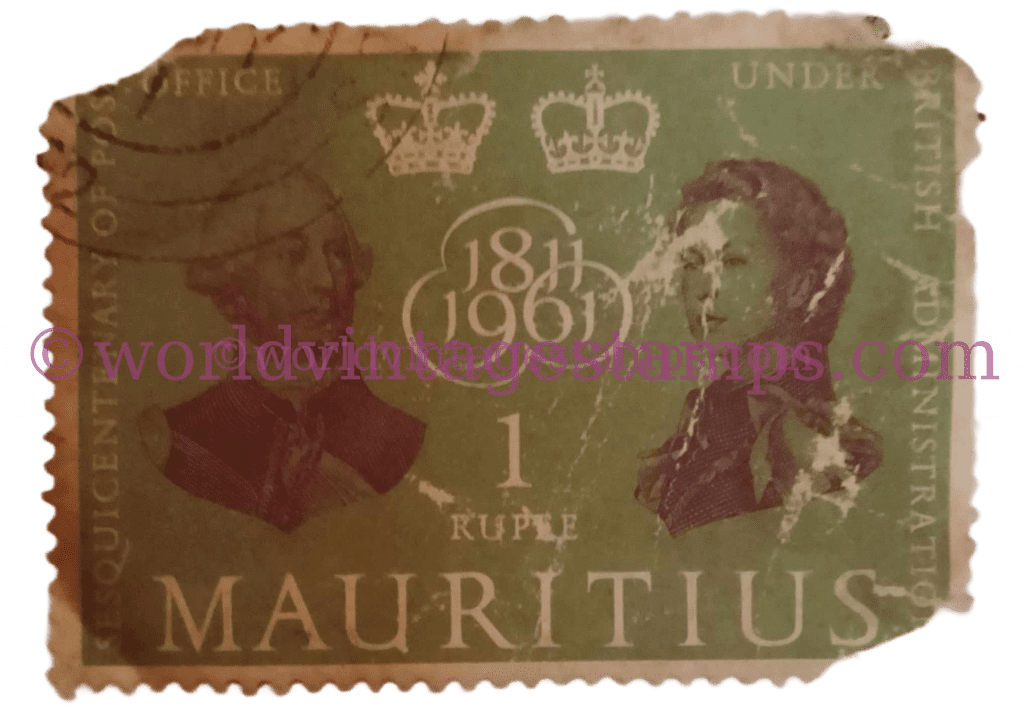
Face Value: 1 Mauritian Rupee
Issued on: 1961-01-11
Series: British Post Office
Emission: Commemorative
Watermark: St. Edward’s Crown Block CA Multiple [Up]
The first postal service in Mauritius was established during French colonization in the year 1772. However, after the British took over Mauritius in 1810, the postal service deteriorated and primarily offered basic overseas services. Nevertheless, in response to pressure from the local newspaper Le Cernéen, the British decided to revitalize the postal service on the island in 1834, and by 1835, it had already become a success.
On the postage stamps, you can see King George III on the left, who was the King of Great Britain and Ireland during the establishment of the British Post Office in Mauritius. On the right, you can find Queen Elizabeth II, who was the Queen of the United Kingdom and other Commonwealth realms during the 150th anniversary of this event.
Mauritius 1966-69 Postage Due Stamps

Issued on: 1969-01-07
Face Value: 4 Mauritian Cents
Series: Postage Due Stamps 1969
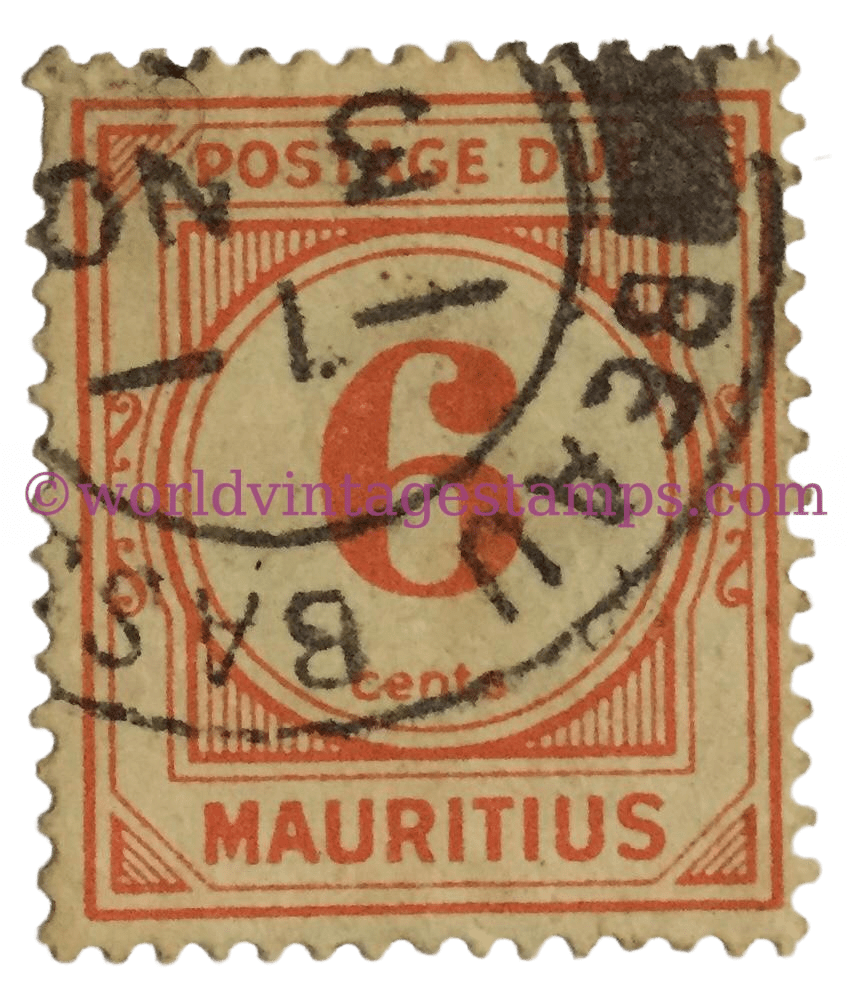
Issued on: 1969-01-07
Face Value: 6 Mauritian Cents
Series: Postage Due Stamps 1969
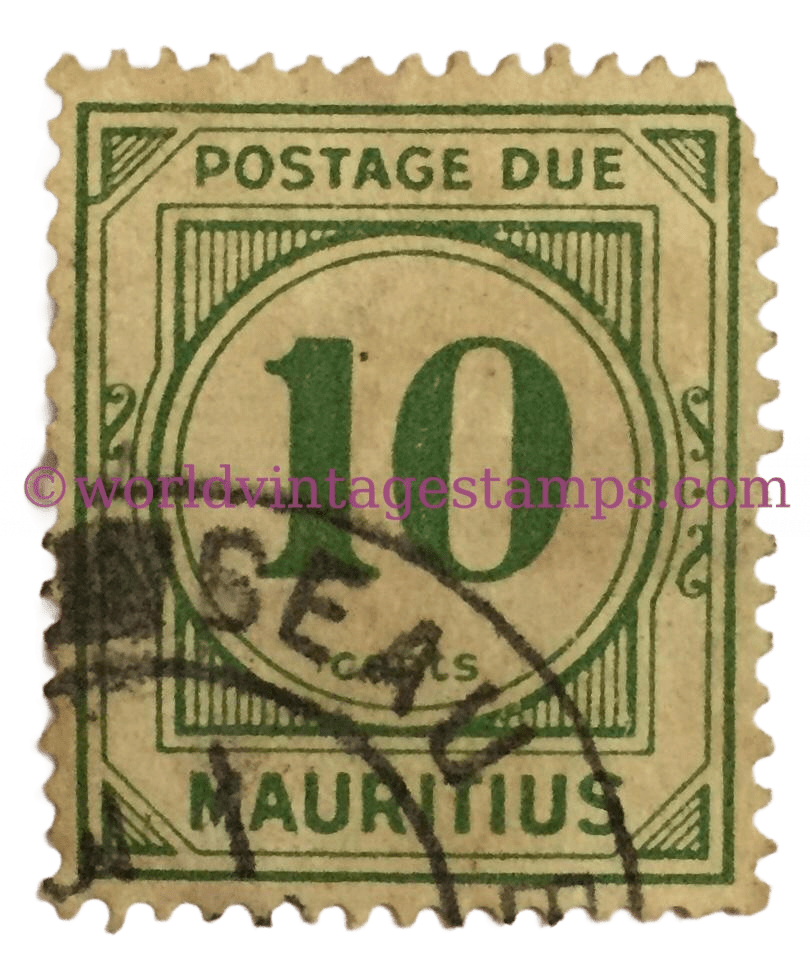
Issued on: 1967-02-16
Face Value: 10 Mauritian Cents
Series: Postage Due Stamps 1967

Issued on: 1966-01-03
Face Value: 20 Mauritian Cents
Series: Postage Due Stamps 1966
Emission: Postage Due
Watermark: St. Edward’s Crown Block CA Multiple [Up]
Postage Due is a term used to describe underpaid mail, and it represents the amount that the recipient of the mail must pay to receive it due to undercharging from the sender. Initially, some countries would return undercharged mail to the sender. However, in the early days, mail carriers would manually write the due amount (e.g. ‘Due 2 Cents’), which lacked proper control and was susceptible to abuse by postal workers. As a result, the need for better control emerged. Some improvements included marking mail with a ‘T’ and writing the due amount in black ink. Eventually, handstamps were introduced.
Different countries adopted various methods, combining elements such as the ‘T,’ black ink, and handstamps. Over time, there was a shift towards indicating the amount to be charged rather than highlighting the missing amount. In 1859, France found a definitive solution by introducing the first Postage Due Stamp, which was affixed at the delivery office before reaching the recipient. This practice was eventually adopted by other countries.
Postage Due Stamps also found use in other contexts, such as magazine subscriptions. The stamp designs were typically simple, as they were mostly used for domestic mail.”