
Mauritius 1937 King George VI Coronation Commemorative Postage Stamps
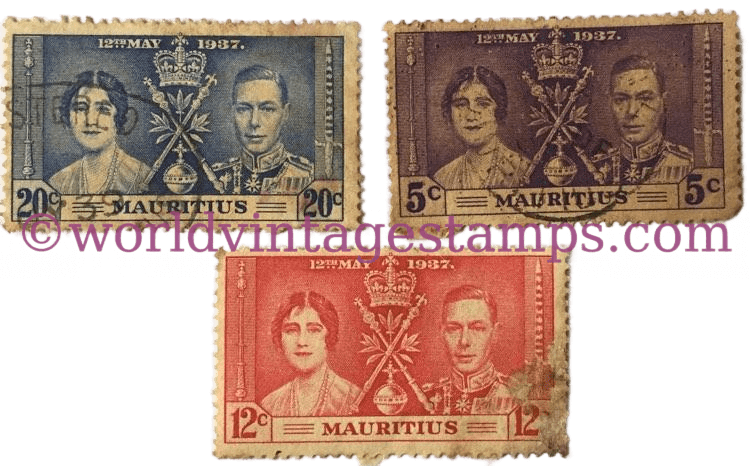
On the 12th of May, 1937, Mauritius issued a set of postage stamps to celebrate the coronation of King George VI and his spouse, Elizabeth Bowes-Lyon also know as “Queen Elizabeth The Queen Mother”, as the king and queen of the United Kingdom and the Dominions of the British Commonwealth. King George VI ascended the throne after his brother, Edward VIII, was abdicated in 1936 due to his choice to marry Wallis Simpson, who had been divorced twice before.
The stamps were issued in various denominations and colours, covering different rates, and featured portraits of both Queen Elizabeth The Queen Mother and King George VI.
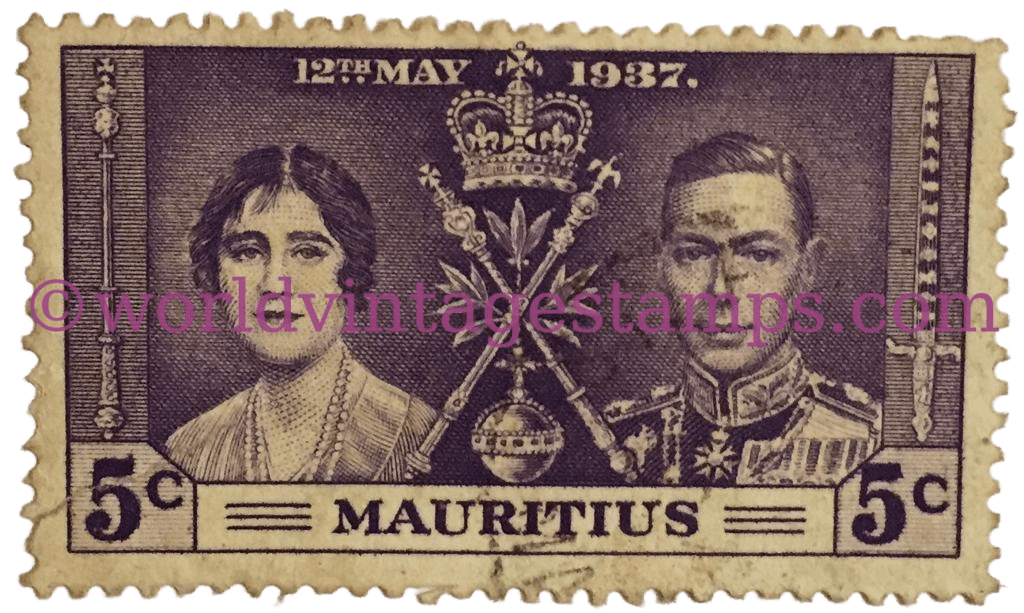
Face Value: 5 Mauritian Cents
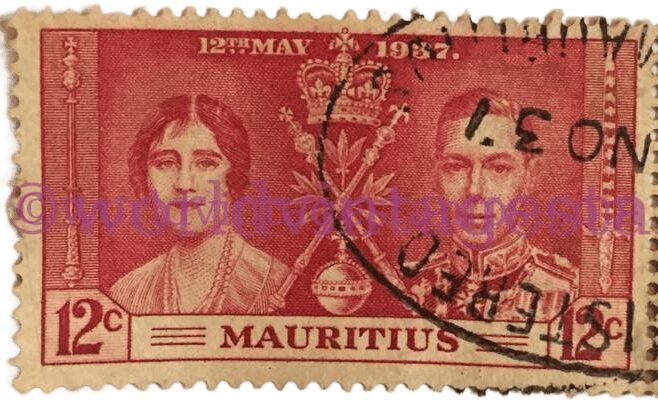
Face Value: 12 Mauritian Cents
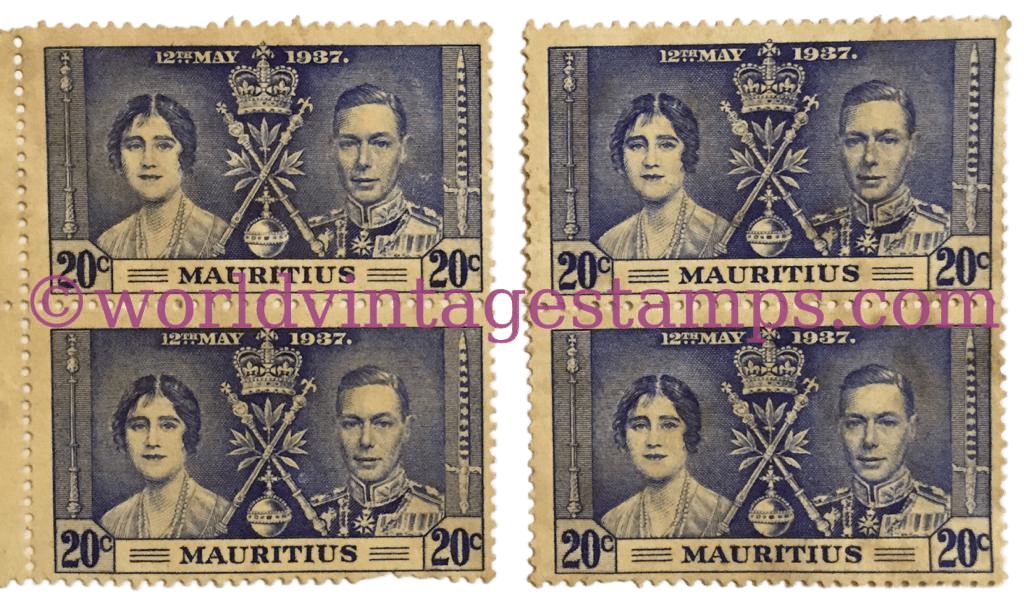
Face Value: 20 Mauritian Cents
Series: Coronation
Emission: Commemorative
Watermark: Crown over Script CA Multiple [Up]
Mauritius 1953 Queen Elizabeth II Coronation Commemorative Postage Stamps
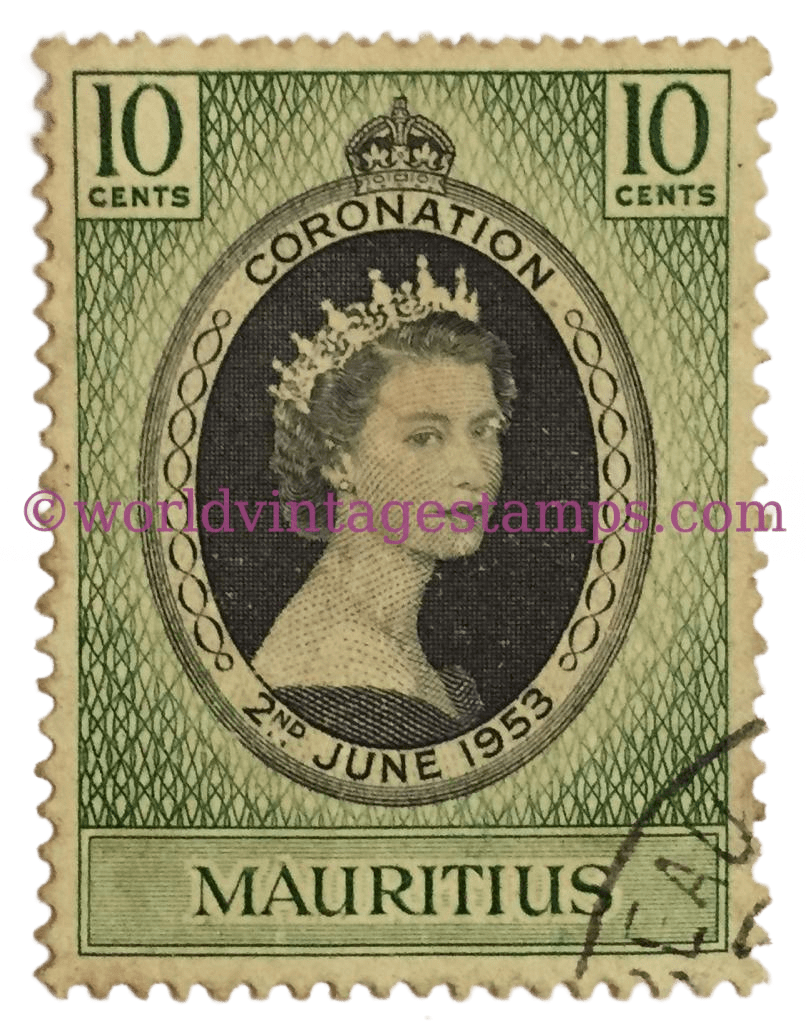
Face Value: 10 Mauritian Cents
Series: Coronation
Emission: Commemorative
Watermark: Crown over Script CA Multiple [Up]
Similar to King George VI’s Coronation Celebration on the 2nd of June 1953, Mauritius issued postage stamps to commemorate the Coronation Celebration of Queen Elizabeth II. She was the daughter and successor of King George VI. Having ascended to the throne at the age of 25, Queen Elizabeth II became the first British monarch to achieve a Platinum Jubilee on February 6, 2022, marking 70 years of her reign.
It should be noted that Mauritius was under British colonial rule from the year 1810 to 1968, which is why British events were reflected in the designs of Mauritius postage stamps during that period. Mauritius gained independence on the 12th of March 1968 and remains part of the Commonwealth. These stamps were used for mailing letters and parcels and are now sought after by stamp collectors.
Commemorative Stamp
In the context of postage stamps, commemorative emissions refer to stamps that have been issued to mark special occasions, individuals, or anniversaries. These stamps stand apart from the standard series and are available for purchase only within a limited timeframe. They serve to highlight particular events of cultural, historical, or symbolic significance.
Interesting Facts
Imperial State Crown
This video is from “Royal Collection Trust” YouTube Channel.
In 1660, during the restoration of the monarchy, a new crown was made by Sir Robert Vyner for King Charles II, and since then, 10 versions have existed. The latest version of the crown, named “Imperial State Crown,” was worn by King George VI in 1937, followed by Queen Elizabeth II and the current King of England, Charles III. The State Crown was worn by the King or the Queen to walk out of Westminster Abbey after the coronation ceremony and at the State Openings of Parliament. Imperial State Crown, being one of the Crown Jewels of the United Kingdom, represents the sovereignty of the British monarch; it is embellished with 2,901 precious stones.
Cullinan II is the second-largest stone cut found on the front of the crown band; it was cut from the Cullinan Diamond, also known as the “Second Star of Africa.” Back in 1905, this majestic diamond was mined in South Africa, and after staying unsold for two years, it was presented to King Edward VII in 1907.
At the back, you can find a large oval blue Sapphire known as the “Stuart Sapphire.” It is believed to have originated from an Asian country (either Afghanistan, Sri Lanka, Myanmar, or Kashmir).
At the top of the band, there are two arches, or half four arches, each arising from a cross-pattée (symbolizing the religious connection of the monarch).
The front cross is mounted with an irregular cabochon red spinel named the “Black Prince’s Ruby.” It is one of the earliest parts of the crown jewels, dating back to around the 14th century. It was mined from Badakhshan (nowadays Afghanistan and Tajikistan).
The other three crosses are mounted with step-cut emeralds. There are four fleur-de-lis, each having a mixed-cut ruby at the center.
The Queen Elizabeth Earrings, suspended at the intersection of the arches, are four large pear-shaped pearls in rose diamond caps that originated back in the year 1533. Pope Clement VII gave Catherine de Medici seven pearls (which form part of the four large pearls) on her wedding day to Henri II (the king of France from 1549 until his death). Eventually, Catherine de Medici presented them to her daughter-in-law Mary, Queen of Scots (the cousin of Queen Elizabeth I), which were sold to Queen Elizabeth following the imprisonment of Mary, Queen of Scots.
Among the other tremendous ornaments, diamonds, arches, designs such as oak leaves, large pear-shaped pearls in rose diamond (Queen Elizabeth Earrings), and many more, the crown’s historically older gemstone is found on the top in the center of the cross-pattée, namely the “St Edward Sapphire.” It is believed to have been found in the coronation ring of St. Edward (Edward the Confessor), the King of England in 1042. He was one of the last Anglo-Saxon kings of England, and it is not clear how the gem survived the English Civil War. It was eventually presented to Charles I following the restoration of the monarchy.
Each part of the crown carries a historical background of the monarchy, being well-detailed and crafted to be its unique piece that it is today.
Royal Collection: Queen Elizabeth II in Coronation Robes, Sir Herbert James Gunn
Jennifer Scott, the Royal Collection Curator of Paintings, discusses the portrayal of Queen Elizabeth II in her Coronation Robes, captured by Sir Herbert James Gunn. This exquisite portrait is currently exhibited in the Garter Throne Room at Windsor Castle.