
For philatelists and history enthusiasts alike, Canadian postage stamps offer a captivating glimpse into the nation’s past. This article delves into the history, significance, and value of these miniature works of art.
A Brief History of Canada
Canada’s history is deeply rooted in European colonization. Initially claimed by France, the territory eventually fell under British control following the Seven Years’ War (1756–1763). The British victory ceded all French North American possessions to the British Crown.
To manage the diverse population, the British divided the colony into Upper Canada (English-speaking) and Lower Canada (French-speaking) in 1791. Over time, additional colonies such as New Brunswick, Nova Scotia, and Prince Edward Island were established.
Tensions between English and French communities escalated, leading to the Confederation of 1867. The British North America Act united Ontario (formerly Upper Canada), Quebec (formerly Lower Canada), New Brunswick, and Nova Scotia into the Dominion of Canada. This marked a significant turning point, setting the stage for Canada’s westward expansion.
Why Did Canada Issue Its Own Postage Stamps?

Canadian stamp with map of British empire – 2 cents 1898. Source
The introduction of Canadian postage stamp was crucial in establishing a standardized postage rate system, which helped streamline postal costs. It also generated revenue for the government and represented a step toward greater autonomy from the British postal system, reflecting Canada’s growing self-governance. Initially, stamps focused on practical postal needs, but over time, they became a medium for celebrating Canada’s culture and history.
How Did Canada Begin Its Postal System?
On May 21, 1849, a motion was recorded in the legislative assembly’s journal, calling for the establishment of a general post office for the province. The motion was introduced in the assembly on May 22, passed on May 25, and received the assent of the legislative council on May 26. A year later, on August 10, 1850, the Post Office Act was passed, introducing the prepayment system, which was implemented with the issuance of Canada’s first postage stamps.
In the early days of Canadian postage, the rate for sending internal mail was 3 pence for paper not exceeding ½ ounce in weight. For mail exceeding ½ ounce but not more than 1 ounce, the cost was 6 pence, with rates increasing for heavier weights. These rates have, of course, changed significantly over time as postal policies evolved.

First air express delivery, at Leaside Aerodrome. First package deliveries were destined for T. Eaton Co. in Toronto. Source
What Was Canada’s First Postage Stamp?
Canada’s first postage stamp was the Three-Pence Beaver, with a face value of 3d, designed for internal mail. The stamp features a beaver in its natural habitat, surrounded by an oval shape, with a royal British crown atop a rose and the letters ‘V’ and ‘R’ (Victoria Regina). Issued on April 23, 1851, and designed by Sir Sanford Fleming, this stamp was groundbreaking because it was the first postage stamp to feature an image other than the monarchy, showcasing an animal instead, even though Canada was still under British rule. While an unofficial postmaster’s provisional from St. Louis, Missouri, depicted two bears in 1845, Canada’s was the first official stamp to feature an animal.

Three-Pence Beaver Canada Postage Stamp. Source
Why Was the Beaver Featured on Canada’s First Postage Stamp?

The North American beaver, one of two beaver species, is native to North America, with fossil records dating back millions of years. The beaver is a large rodent known for its determination and building skills, particularly in constructing dams for safety and survival. The beaver symbolizes industry, perseverance, and adaptability.
Beaver fur was a significant trade item during the early colonization of North America, beginning with indigenous trade between the French in New France, now part of Canada. Over time, the British also became involved in this trade, making it a cornerstone of the economy in the colonies that would later form Canada. Featuring the beaver on Canada’s postage stamp reflects the country’s natural heritage and economic identity.
What Is the Current Value of a Three-Pence Beaver Postage Stamp?
The value of a postage stamp can vary widely based on condition, rarity, historical significance, and market demand. The Canadian Three-Pence Beaver stamp is no exception.
As Canada’s first postage stamp, it holds significant historical value. However, because a relatively large quantity of this stamp exists, its overall rarity is limited. Mint and unused stamps in exceptional condition are still considered relatively rare and can fetch high prices, while used stamps are typically less valuable. For instance, on eBay, Three-Pence Beaver stamps can range from as low as $0.72 to as high as $874.85, depending on condition. At auction houses, these stamps especially the rare mint and unused examples in high grades often command significantly higher prices. Click here for a guide on stamp grading terms.
Pro Tip: Always conduct thorough research before making a purchase. Verify the stamp’s authenticity, seek expert advice for a comprehensive understanding, and check the seller’s reputation. For high-value stamp, consulting a reputable stamp appraiser is strongly recommended. Click here for a guide on how to determine stamp values.
Canada’s First Three Postage Stamps: 3d, 6d, and 12d

Canada 6d Postage Stamp – Prince Albert. Source
Canada’s first postage stamps were issued in three denominations: 3d for the Three-Pence Beaver, 6d, and 12d. The 6d postage stamp featured a portrait of Prince Albert, drawn by William Drummond Esq. The 12d stamp, equivalent to one shilling, featured an image of Queen Victoria, reproduced from a full-length painting by Alfred Edward Chalon.
The Rarest Canadian Postage Stamp: The Twelve Penny Black (The Black Empress of Canada)

Canada 12d Postage Stamp – The Black Empress of Canada. Source
The Twelve Penny Black, also known as The Black Empress of Canada, is one of the three original Canadian postage stamps. This stamp features a portrait of Queen Victoria, often called the Chalon head due to its origin in Alfred Edward Chalon’s artwork. Printed in black ink on a white background, it was issued on June 14, 1851.
The Twelve Penny Black is the rarest Canadian postage stamp and one of the most valuable stamps worldwide. Of the 51,000 copies produced, only about 130 are believed to remain, though the exact number is unknown. The stamp’s value can range from $400,000 to $500,000, depending on its condition and other factors. The last public sale of a Twelve Penny Black occurred in 2011, fetching $425,000.
Sir George-Étienne Cartier’s Key Role in Canada’s Confederation and Colonial Postage Stamps
Canada’s colonies began issuing their own local postage stamps in 1851 after assuming control of the local postal system from the London General Post Office. Individual postage stamp issuance ceased following the formation of the Canadian Confederation, a process heavily influenced by the statesman and Father of Confederation, Sir George-Étienne Cartier.
Cartier, born in Lower Canada (now Quebec), was a key figure in the unification of the colonies. His political influence was so significant that he was often referred to as the “Kingpin of Confederation.” Driven by concerns about American expansion, Cartier played a pivotal role in negotiating and implementing the terms of Confederation.
Before his involvement in Confederation, Cartier had a distinguished legal career. He was exiled to the United States in 1837 due to his participation in the Lower Canada Rebellion. In 1838, Cartier returned to Montreal and began to influence politics. He made significant contributions to Canada’s development. In 1848, Cartier officially entered the political arena. He replaced the outdated Custom of Paris with the Civil Code of Canada, abolished seigneurial tenure, and reformed civil law. Cartier also played a key role in the construction of the Canadian Pacific Railway and the Grand Trunk Railway.
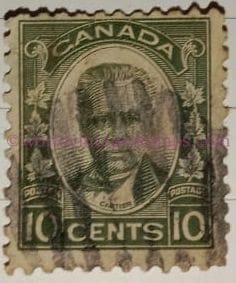
Sir George-Étienne Cartier (1931) – Canada Postage Stamp
List of Canadian Colonial Postage Stamps:
- British Columbia and Vancouver Island: Issued separate postage stamps in 1860. These two colonies merged in 1866 and subsequently issued stamps together as a unified entity.
- New Brunswick and Nova Scotia: Both introduced their first postage stamps in 1851.
- Newfoundland: Issued its first postage stamp in 1857 and continued to do so until 1947.
- Prince Edward Island: Issued its first postage stamp in 1862.

One of the first stamps of Nova Scotia, issued in 1851. Source
The Legacy of Canadian Postage Stamps
Canadian postage stamps are more than just a means of sending letters; they are miniature time capsules that encapsulate the nation’s rich history, cultural identity, and evolving sovereignty. From the Three-Pence Beaver to the Twelve Penny Black, each stamp tells a story of Canada’s journey from a collection of colonies to a unified, independent nation.